The idea is a static body VTOL design that can hover stable in the air, and also go at high speeds very efficiently with wings. Could modify dimensions as needed, but general idea, I’m unsure if there’s a major design issue?
Rotor spin needs to even out or else it would spin all the time, that’s why drones have an even amount of rotors AFAIK.

Hey you stole the design I came up with when I was 7 years old. I’ll see you in court
I was 6 and my mum said I was the bestest engineer ever. I asked ChatGPT now and it confirmed I am absolutely correct. ChatGPT is never wrong.
Without going into the aerodynamics, which plenty of others have gone into, the main problems I see are:
- The structural integrity of the wings is effectively kneecapped by those 2 rotors. There’s almost no material remaining where the wings meet the body and there’s a lot of force that needs to transfer through that area.
- Unless the center of gravity is within the triangle defined by the rotors, you’re going to have a really bad time trying to control that thing during vertical flight.
- Where would all the fuel and drivetrain for 4 props (which all take up significant space) live? There is almost certainly minimal room for any sort of cargo or payload.
- Why would you want a “thick unitary” frame (I’m assuming you mean unibody here)? We put thin skin with a supporting skeleton on aircraft to reduce the weight of the craft itself without sacrificing too much rigidity, which makes more weight available for fuel and/or cargo.
Is this a generated image? In addition to the font being the one that generated images tend to use, there’s some callouts here that also just don’t make sense: the double “pure one-piece static frame” and “thick, unitary body frame” callouts are, I think, saying the same thing in two unintuitive ways, and along with the “long clean wings” callout, none of them really have anything to do with the design concept here. Additionally, you’ve repeated the “maximum efficiency winged vtol configuration” and “cheapest minimalist one-piece construction” notes on the side, neither of which are necessarily true or provable from first principles based on the design- quite the opposite, if anything.
I got this one, I think it may be a bit better.

Great constructive feedback, thank you. Would you want to try to create a better design with this concept in mind? I think you have a clear understanding of what the idea is.
VTOL is always ass, every aeroplane should be slung on a massive slingshot into the sky because its cool as shit. No propulsion, the slingshot has to throw you the whole way.
…go on
But no digital slingshots, they break when they get wet, only steam slingshots
every aeroplane should be slung on a massive slingshot into the sky
Winch launching gliders is a thing.
So 99% of the time this thing is in level flight using one motor to carry 3 paperweights.
isn’t that what helicopters do?
edit: nevermind I see what you mean, 3 of the 4 rotors wouldn’t be doing anything
And no cargo. There’s not much room as drawn for anything else. The center of gravity with an engine up front would be fun. Maybe not impossible, the A310 couldn’t fly empty and was a pain to get the CG back enough.
You could theoretically run the front engine to help offset the weight
I have wondered about the prospect of an aircraft carrier that uses rotary-wing drones to launch and recover the fixed-wing aircraft. That’d give you a lot more flexibility as to the form factor of the ship, since you don’t need to do the deceleration or acceleration on the ship, let you launch and recover directly from stuff like submarines (and not like the I-400 class, which was really a seaplane carrier).
The US has been working on fixed-wing UAVs that are launched and recovered from a fixed-wing airborne aircraft carrier, Gremlins. If you can do that, I’d imagine that it’d also be possible to launch and recover them from a rotary-wing drone.
You don’t really gain anything from putting the props in the wings, and you lose a lot of wing strength.
Take a look at https://elroyair.com/ for a real-world vtol drone with fixed wings.
Yea but don’t the flat rotors cause drag? The point being, the rotor inside the wing is not causing drag.
oh they definitely cause some, but not nearly as much as the wing breaking because you’ve concentrated the stress into two small areas, or from having to add so many rotors inside the wings that they’re just one rotor next to another.
Take a look at a top down picture of one to get an idea of the swept rotor to wing area ratio. The swept rotor area is almost twice the wing area. If all those rotors were inside the wings, there wouldn’t be any wings left.
The point being, the rotor inside the wing is not causing drag.
It would absolutely cause drag, just not from the wing’s leading edge but from wake turbulence added to the air flow that’s still going over the wing.
Probably not as much as having an exposed rotor, also maybe you could angle the edge of the hole so the air flows over it like a ramp.
Probably, maybe, possibly, perhaps. All fun words. Having a hole in the wing is probably way worse than some windage. It cuts the balls out of the laminar flow and pressure differential. I’m no pilot, but as a sailor I can tell you that sails do not perform very well with holes in them.
Why not make the little ramp at the front of the wing so the air flows over it like a ramp and then you can do away with the entire rest of the wing?
Indeed, you clearly know what you’re talking about. A little ramp at the front of the wing would help, with a divet on the other side of the hole to smooth the air flowing down into the other side.

No. The rotors are far too small. Simplify the problem down to a ratio of the weight of the craft to the surface area of the rotor blades. What kind of material would you use for them that could withstand that many pascals, and not fail catastrophically when spinning at the required RPM? Compare the surface area of helicopter rotors, or even rotors on FPV drones. They all have rotor diameters that exceed the dimensions of the aircraft body for a good reason.
ELI5: “It’s a question of weight ratios. A 5oz bird can’t carry a 1lb coconut!”
Your wings would fall off. There is almost no material where they should be the strongest because there is a giant hole in it.
The center of gravity has to be forward of the side props or you’ll have a hard time balancing it. This means the mass of fuel/battery, engine and payload have to be around there.
You’ve seen how big the props are on toy drones, helicopters, or the V-22 compared to the rest of the thing? They need to be that big to provide enough lift.
Did the ai that made this slop know it was supposed to fly?
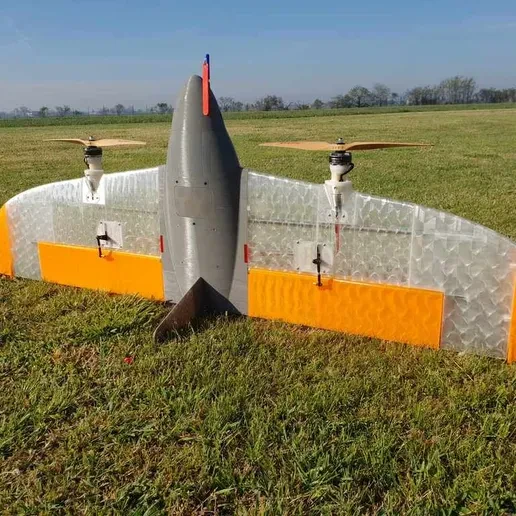
I’m pretty sure I’ve seen small (i.e., handheld-sized) commercial UAVs that fly like this. But as others have pointed out, at any realistic size you start to run into a lot of problems:
- The VTOL rotors will create massive drag when they’re not in use. There’s a reason virtually every aircraft with embedded VTOL jets engineered ways to cover them up during level flight. This cascades into a whole bevy of complexity issues.
- When you’re not using them, you’re lugging around 3 out of your 4 rotors for no reason.
- You’re also sacrificing a lot of internal volume for your lift fans. This isn’t so much a problem in small UAVs, again, but it’s not great if you were hoping to use that capacity for fuel or cargo.
So yeah, like others said as well - now that we have tailsitter drones of moderate size, there’s not really a use for this layout.
There’s a reason virtually every aircraft with embedded VTOL jets engineered ways to cover them up during level flight.
Or ways to pivot them to horizontal and use them for forward thrust…
But, honestly, I think ones like OP’s could work relatively well if you engineered the hell out of the aerodynamics and made sure that the openings would be inside slipstream ‘shadows’ and not exposed to much airflow while in forward motion. That could only be well-optimized for one airspeed, though, so it wouldn’t be practical for an aircraft that wants to fly at different speeds a lot. But for one intended to always cruise at a set speed, I think it could work.
Other criticisms are still totally valid, though.
Maybe, but what’s the advantage over tailsitters like this?
Or even the tilt-rotor quads/tris like the Flightory Stallion
The idea is for being able to hover while dropping cargo on a zip line, the design is inspired by the zipline uber eats.
Apparently the issue with this style is landing, for pilot ones anyway.
It would probably be possible to make functional (especially on a small scale), but wouldn’t be very efficient. With four rotors to drive, you’re going to have significant weight, and on top of that you have the flat profile that will make it difficult to fly vertically. At the same time, the large spaces for the propellers mean it won’t be as sturdy or aerodynamic, and you’ve only got one propeller for forward thrust, so it won’t be able to go very fast. Very optimisticly, I expect that you’d be left with a vehicle that can barely take off or land, although might perform a bit better than something like a helicopter once in the air, but not competiting with existing VOTL designs.
Maybe you could create a slight angled bump in front of the holes for the vertical rotors so air stream goes over without causing much drag?
No, that’s basically how air brakes work by causing even more turbulence.
I was assuming something like that would be used, but even then, its still a bunch of additional drag for little or no gain relative to existing options. As another comment pointed out, tailsitters are pretty comparable in benefits, but they also lack the the drag issues and will likely be at least a little more stable in vertical flight.
The major issues I could see with this design are:
- the pitch is going to be really hard to control with two aft rotors and a single forward rotor in vertical flight
- structural challenges with the wing since there’s a big hole now where the spars go through
- depending on the type of fuel it uses, it has limited capacity in the wings for a wet wing and would take up a significant portion of the fuselage for a large capacity battery setup
Doesn’t a drone like this already actually exist? At least as like a remote control toy, surely.
yep, seen similar looking ones a decade before
don’t know how good they are though, never really looked into it even back then
Maybe but prop planes have pretty short takeoffs and landings anyway, from the little I know.
The issue you have here is weight, how many engines do you need to power those 4 props.

